
System Integration / Emergency scenario
Connecting Fire Detection to Access Control — Emergency Door Release
Connecting fire detection to access control: when an alarm is received, the escape doors are released and passage is possible — automatically, without looking for a key or card.
Example scenario
What happens at the doors when a detector detects smoke



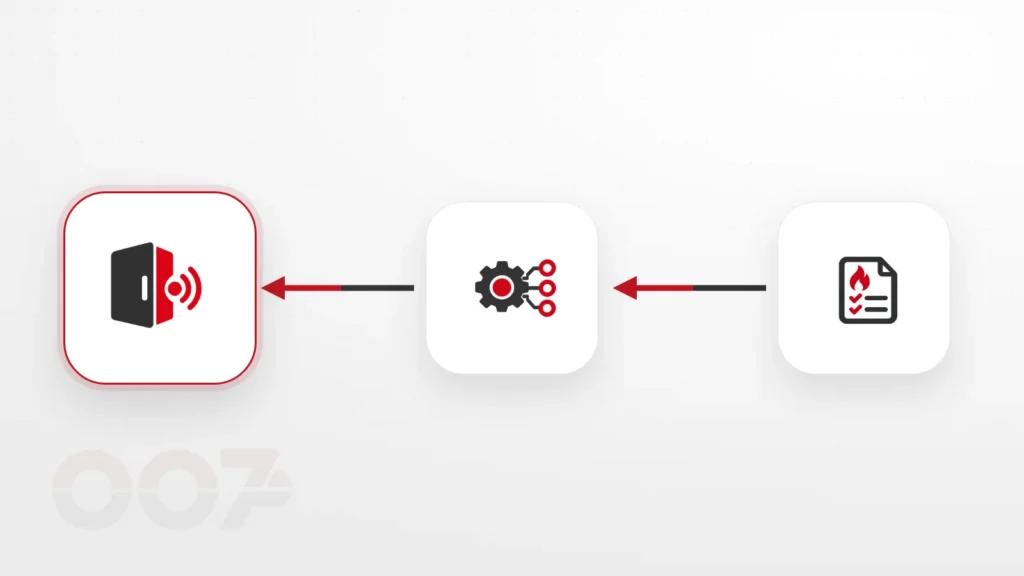
- A smoke detector detects an event and reports to the fire detection panel.
- The panel passes a release command to the access control system.
- The doors on the escape routes are released, and the person in charge receives an alert.
The scenario is illustrative. The actual activations are set according to the building's design and the safety consultant's instructions.
What the service includes
How the scenario works
Detecting the event
The fire detection system detects smoke or heat in a zone and triggers the defined scenario.
Passing the command
A dedicated interface passes the signal to the access control system or directly to the locks.
Releasing the doors
The doors on the escape routes are released according to the design — in the event zone or throughout the building.
Working during a power cut too
Choosing the locks and the connection method so that exit remains possible during a power cut too.
Returning to normal
Returning the doors to locked only after the event is reset, and in a controlled way.
End-to-end testing
Running the scenario for real and checking every door that is supposed to be released.
How we work
We design, connect and test every door.
Every door that is supposed to be released is tested for real, not just on paper.
-
Mapping doors
Which doors are on the escape routes and how they lock.
-
Interface design
Choosing how to connect the systems and the locks.
-
Installation and configuration
Connection, defining zones and scenarios.
-
Testing and documentation
Running the scenario and checking every door.
Safety versus security
Locked day to day, free exit in an emergency.
The interface between the systems makes it possible to keep full security day to day, without giving up safe exit in an emergency. The decision on which doors are released is made at the design stage, according to the building and the safety requirements. For details on the systems themselves: access control and fire detection system inspection.
Releasing doors in a fire: how fire detection is connected to access control
A door with access control has a built-in conflict between security and safety: day to day it needs to stay locked, and in a fire — to open immediately. Connecting fire detection to access control resolves this conflict: the fire detection system sends a signal, and the defined doors are released.
Which doors are released
Not every door in the building needs to be released in every event. At the design stage we define the doors on the escape routes, the zones and the sequence of actions — in coordination with the building’s activation regime where one exists.
The type of lock matters a lot
An electromagnetic lock releases when the power is cut, so it is especially suitable for escape doors; an electric lock in the door can work either way, depending on its type. We choose the lock and the connection method so that exit remains possible during a power cut too, and test every door for real. See also access control systems. The service is available in the North — from Netanya and Hadera, through Haifa, Afula and Nof HaGalil, to Kiryat Shmona and the Golan Heights.
Photos
from the field.
Frequently asked questions
Frequently asked questions about connecting fire detection and access control
Can an existing fire detection system be connected to existing access control?
Usually yes. We check the types of systems and locks and match the interface.
Are all the doors in the building released?
Not necessarily. At the design stage we define which doors are released — according to the escape routes, the zones and the requirements.
What happens in a power cut?
It depends on the type of lock and the connection method. In the design we choose a solution that ensures safe exit in that situation too.
How do you know it really works?
We run the scenario in a coordinated test and check every door. It’s recommended to repeat the test as part of periodic maintenance.
Is this connection tested in the activation regime test?
In buildings that require an activation regime test, door release is one of the scenarios tested. That’s why it’s worth checking it in advance — see integrated safety systems.
Which areas do you carry out the connection in?
Across the North — from Netanya and Hadera, through Haifa, Afula and Nof HaGalil, to Kiryat Shmona and the Golan Heights.
Want to connect fire detection to access control?
Tell us which systems the building has, and we'll check the right way to connect them.