

System Maintenance & Inspection / Full scenario test
Integration and Activation Regime for Fire Safety Systems
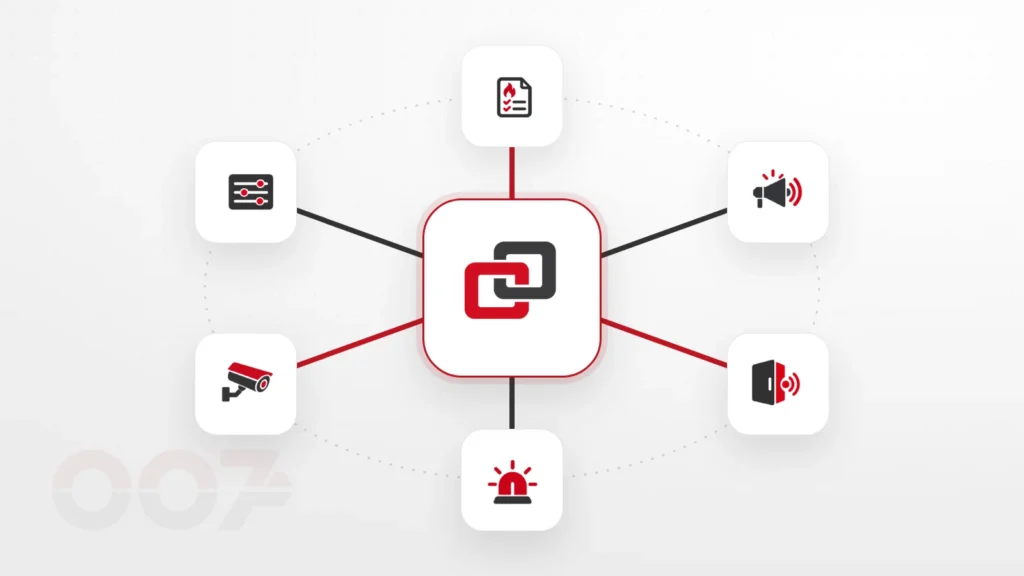
Testing all the systems that are supposed to work together in an event — fire detection, emergency PA, access control and other systems — as one scenario, and preparing for the activation regime test.
Example scenario
Activation regime: one event triggers the whole building


- A detector detects an event and reports to the fire detection panel.
- The panel runs the scenario set in the building's safety design.
- In the test we make sure every system actually responded — each on time and in the right order.
The scenario is illustrative. The actual activations are set according to the building's design and the safety consultant's instructions.
What the service includes
What we test in an integrated scenario
Mapping the interfaces
A list of all the activations between the systems — who triggers whom, and under what condition.
Defining scenarios
What is supposed to happen in an event in each zone: a message, door release or activating other systems.
Activation for real
Running the scenario on site and checking every end point, not just the panel.
Timing and sequence
Checking that the actions take place in the right order and at the right time.
Recording failures
Documenting every interface that didn't respond as expected, with an explanation and a repair recommendation.
Repair and re-testing
Handling failures within our field and re-running the scenario until the result is correct.
How we work
We test the scenario, not just the components.
The test is coordinated in advance to minimize disruption to the building's routine activity.
-
Mapping
Which systems are connected and what each is supposed to do.
-
Test planning
Coordinating a date and zones with the building management.
-
Activation
Running the scenarios and checking every end point.
-
Report
Findings, failures and recommendations for what's next.
Who carries out the official test
We prepare — the accredited laboratory approves.
Under Commissioner’s Directive 536, the activation regime test is carried out by the Standards Institution of Israel or a laboratory recognized for SI 1220 Part 3; a periodic test can also be carried out by an authorized professional, under the conditions set by the Fire and Rescue Authority. Our role is to make sure in advance that the scenarios work and to fix failures, so the official test passes without surprises.
Activation regime: what it is and why it is tested
An activation regime, or fire safety system integration, is the sequence of actions that takes place in a building when the fire detection system detects an event: which doors are released, what is heard over the emergency PA, what happens to the lifts, the smoke dampers and the smoke control systems. The Fire and Rescue Authority’s Commissioner’s Directive 536 sets the basis for the activation regime and the obligation to test it in buildings where it is required.
Why testing each system on its own isn’t enough
The fire detection system can pass a periodic inspection, and access control can work perfectly day to day — and still, in an event, the door won’t release because the interface between them was disconnected in the last renovation. That’s why an integration test examines the full scenario, not just the components.
How we prepare the building
We map the activation table, run each scenario in the designated zones, document every interface that didn’t respond and fix what’s within our field. That way the official test by the Standards Institution or the accredited laboratory is carried out on systems that have already been tested. The service is available for buildings in the North — from Netanya and Hadera, through Haifa, Afula and Nof HaGalil, to Kiryat Shmona and the Golan Heights.
Photos
from the field.
Frequently asked questions
Frequently asked questions about integrated safety systems
How is this different from an ordinary fire detection system inspection?
An ordinary inspection checks that the system itself is in working order. An integrated test also checks that everything it is supposed to trigger actually works.
Does the test disrupt activity in the building?
The test is planned in advance, by zone and at hours that suit you, to minimize disruption as much as possible.
Our systems are from different manufacturers — can they be tested?
Yes. The test focuses on the interfaces and the result on site, not on the manufacturer of each system.
What do we get at the end?
A report detailing the scenarios tested, what worked, what didn’t and what was fixed — and a building ready for the official activation regime test.
Do you issue the activation regime approval?
No. The official test is carried out by the Standards Institution, a recognized laboratory or an authorized professional under the conditions set by the Fire and Rescue Authority. We prepare the systems for the test and handle the findings.
Which areas do you carry out integration tests in?
Across the North — from Netanya and Hadera, through Haifa, Afula and Nof HaGalil, to Kiryat Shmona and the Golan Heights.
Do you have several systems that are supposed to work together?
We'll test the full scenario and make sure all the links are connected.